

Tina Lou
Founder · Systems Architect · Product Engineer
The Future of Software
Isn't Building.
It's Deciding What Executes.
AI made generation cheap.
What matters now is:
what gets validated,
what gets executed,
and what survives reality.
I build that layer.
What I Do
Decision Systems,
Not Features
I build across orchestration, validation, and execution—the layers where AI meets production constraints. Not integrations. Not wrappers. The infrastructure that determines what is allowed to run.
AI & Agent Orchestration
Multi-agent systems that generate structured outputs, coordinate across models, and feed deterministic pipelines.
Execution Infrastructure
Real-time systems that translate decisions into actions—with latency, safety, and failure modes accounted for.
Validation Layers
Simulation, scoring, and enforcement systems that determine what is allowed to execute—and what is rejected.
System Signals
Selected Work
Selected Systems
These are not projects. They are systems designed to operate under real-world constraints.
Each system integrates:
generation (AI), validation (simulation), execution (real-time infrastructure), and learning (feedback loops).
I don't build AI features.
I design systems that decide, validate, and execute.
 Warren LabsOrqisCapital Deployment Intelligence
Warren Labs
Orqis
Capital Deployment Intelligence
Core Thesis
Orqis is a capital deployment intelligence system designed to evaluate whether a decision has earned the right to receive capital. Rather than optimizing for historical performance, the system generates evidence through observation, qualification, behavioral analysis, and regime awareness—then continuously validates whether allocation decisions remain justified.
System Responsibilities
- ▸Qualify and disqualify strategies before capital is allocated
- ▸Generate behavioral evidence through paper-first observation
- ▸Compare predicted behavior to observed behavior across market conditions
- ▸Track confidence trajectories and flag degradation
- ▸Govern the promotion path from observation to live capital
- ▸Continuously reassess whether existing allocations remain justified
Research Areas
- ▸Behavioral consistency under regime transition
- ▸Confidence scoring and decay modeling
- ▸Qualification frameworks for capital allocation decisions
- ▸Prediction-versus-reality divergence analysis
- ▸Strategy governance and revocation criteria
- ▸Learning loops between allocation outcomes and decision quality
Current Focus
Current work centers on the relationship between decision confidence and allocation outcomes—specifically, whether the evidence a system generates before deployment is predictive of post-deployment behavior. The broader question is whether capital allocation can be treated as an evidence-based discipline rather than a conviction-based one.
The intelligence layer determines what deserves capital. The execution layer acts on those decisions. KEK Terminal is where validated strategies meet live markets—real-time data, multi-agent coordination, and risk-gated execution.
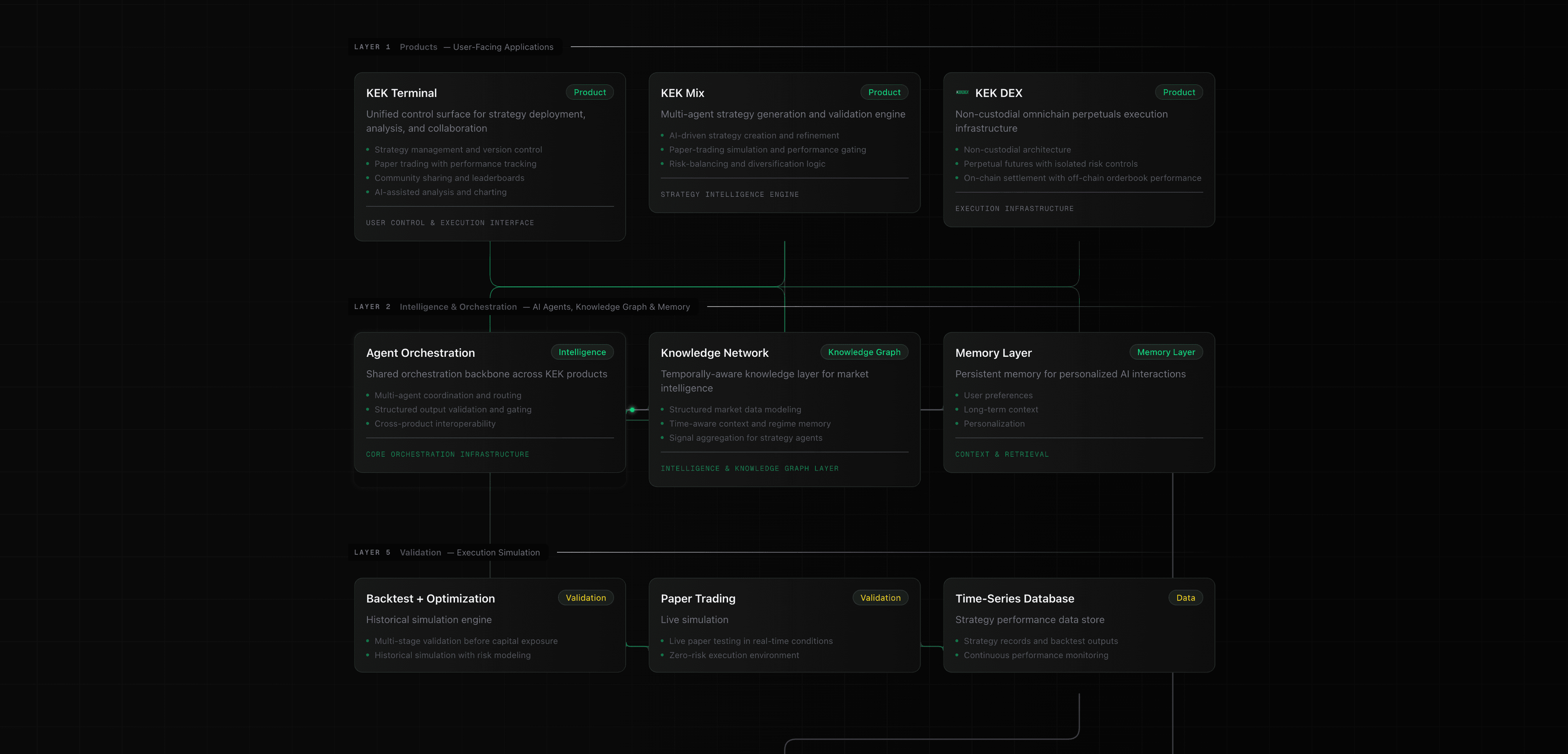
KEK Terminal
AI Trading Interface & Execution Environment
A real-time multi-agent trading system operating on live market data. AI agents coordinate across regime analysis, narrative detection, asset scoring, and strategy generation—with risk-gated execution and sub-second latency requirements.
What I Owned
- ▸Full platform architecture and product design
- ▸Multi-agent orchestration (regime, narrative, asset, strategy agents)
- ▸Real-time data ingestion, WebSocket infrastructure, and execution flow
- ▸Risk-gated paper trading with configurable safety rails
Why It Matters
Proof of end-to-end architectural ownership—from live data ingestion through multi-agent coordination to risk-controlled execution, shipped and operating in production.
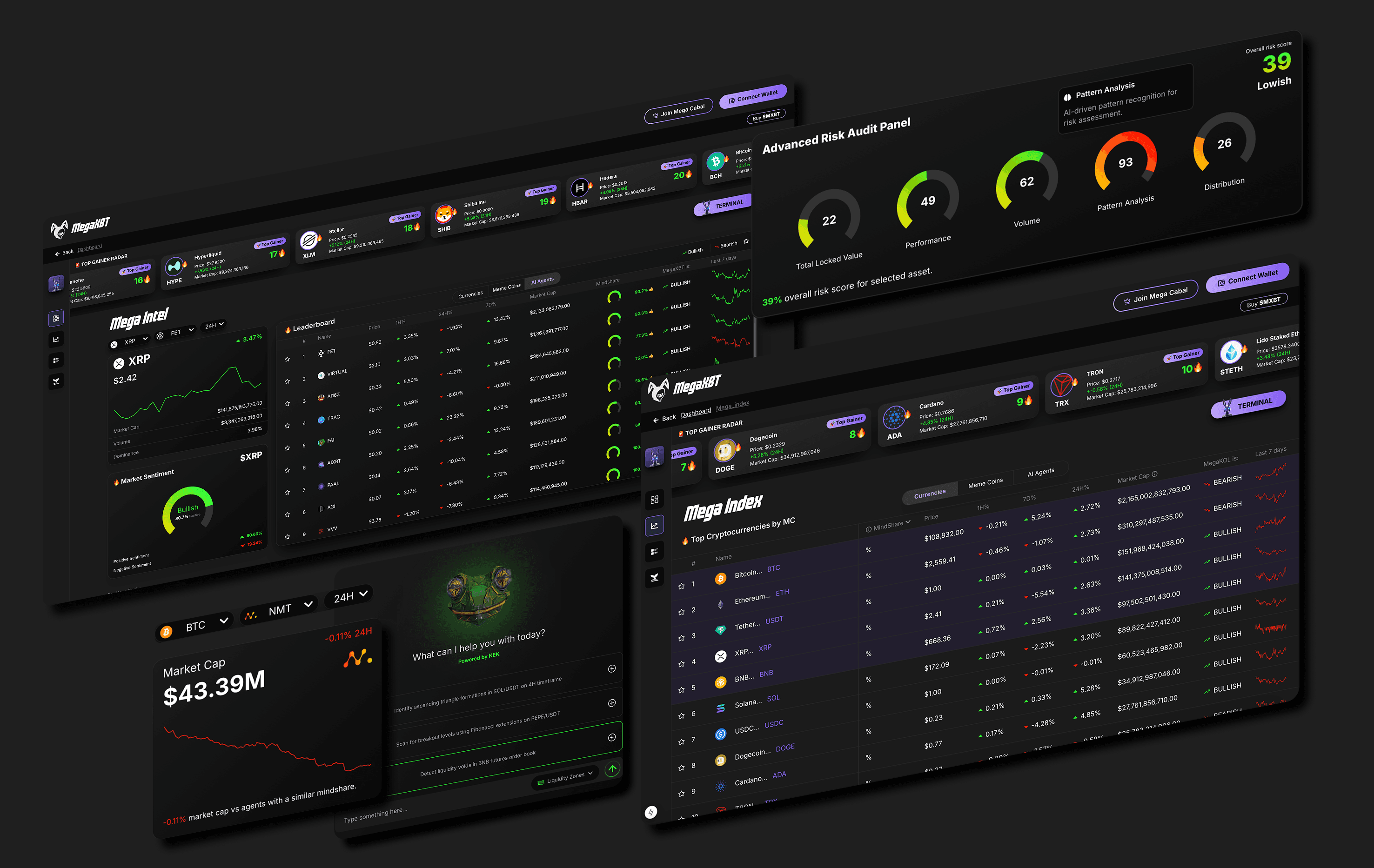
From Generation to Execution Systems
Production AI Architecture
Multiple production platforms where AI is one component in a larger controlled architecture—structured outputs, deterministic validation, execution governance, and graceful degradation under real-world conditions.
Role
Systems Architect & Developer
Systems Challenge
Building the layers between model output and trusted execution—validation, schema enforcement, hallucination detection, and fallback pipelines that maintain reliability when models fail.
Outcome
Repeatable architecture patterns for production AI where every output is validated, structured, and governed before it reaches execution.
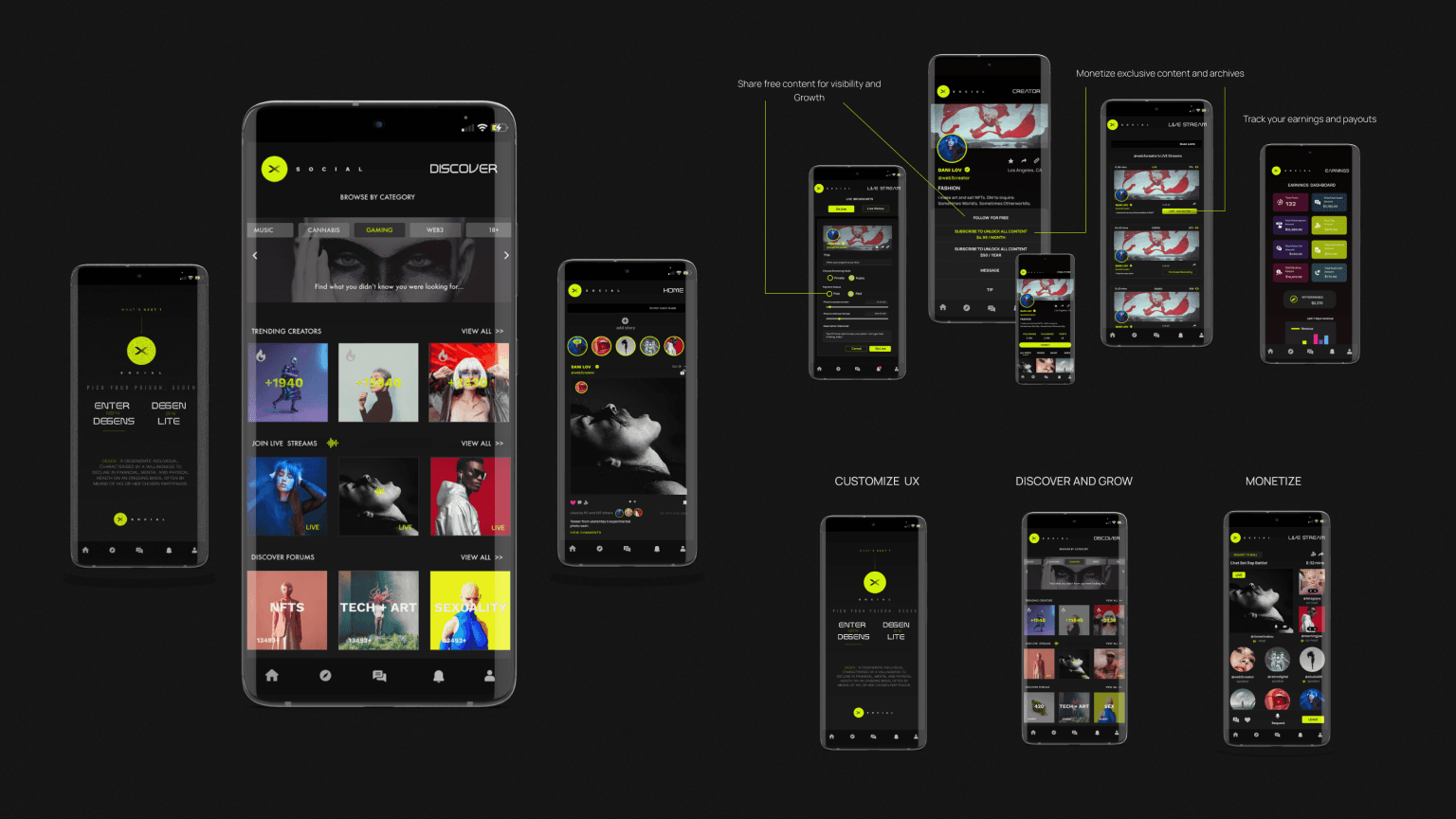
Production & Design Systems
Systems Thinking Before Software
Before software, I built systems in creative production—where scale, coordination, and constraints were real. 70+ published projects, 20M+ impressions, and complex multi-stakeholder pipelines that required the same rigor I now apply to technical architecture.
Role
Production & Design Systems Lead
Systems Challenge
Coordinating complex pipelines of talent, assets, timelines, and distribution across 10+ companies—each requiring coherence at scale across digital, physical, and investor-facing touchpoints.
Outcome
Operational systems thinking applied across domains—the discipline of managing complexity under real constraints, before translating it into software architecture.
About
I Started in Systems.
Just Not Software Ones.
For 15+ years I ran large-scale creative production—70+ published projects driving 20M+ impressions. That wasn't just creative work. It was systems work: coordinating complex pipelines of talent, assets, timelines, and distribution under real constraints.
That operational rigor became the foundation for everything I build now. When I moved into architecture and engineering, the discipline transferred directly: understand the full system before designing the solution, build for the failure modes, validate before anything ships.
Today I architect AI decision systems, multi-agent orchestration pipelines, and validation-first infrastructure. I don't build surfaces. I build the layers that determine what gets executed and what gets rejected.
“I've always been obsessed with how things actually work. Not the interface—the mechanism. Not the pitch—the architecture. That obsession is what makes the systems I build resilient.”

Production to Product
15+ years directing complex production pipelines became the playbook for architecting resilient technical systems.
Systems Over Surfaces
I build the validation layers, decision architecture, and execution infrastructure—not just the interface on top.
Founder Mindset
I operate as an owner. Long-term thinking, full-stack accountability, and a bias toward execution over abstraction.
Approach
How I Work
Most systems fail at the seams.
That's where I design.
Understand the full problem before architecting the solution. Design for the failure modes. Validate before anything ships.
Validation-First
I don’t ship and hope. Every layer gets its own verification—input validation, output gating, integration checks, risk enforcement. Failure happens at the seams. I design for that.
Founder-Level Ownership
I operate as an owner, not a task-taker. I think in terms of architectural durability, service boundaries, and long-term operational cost. I’ll push back on the wrong abstraction and protect the foundation.
Depth Over Speed
I understand the mechanism before I architect the solution. Not the documentation version—the real version. That depth is why what I build survives contact with production.
Decision Lifecycle
The validation-first lifecycle
Every system I build follows the same core cycle: generate candidates, validate rigorously, execute with discipline, and learn from outcomes.
Generate
Create strategy candidates from market context
Validate
Backtest, score, and stress-test every idea
Execute
Paper trade in isolated environments
Learn
Detect discrepancies, improve generation
The four-phase cycle at the core of everything I build.

Philosophy
The Bottomless Rabbit Hole
The name isn't accidental. It's a commitment to going deeper than anyone expects. In a landscape of shortcuts and quick demos, I build from fundamentals. The rabbit hole is where the real understanding lives—and where resilient systems are born.
Depth Over Surface
I don’t skim. Every system I build starts with understanding the problem at its root—the data model, the edge cases, the failure modes. Surface-level solutions create surface-level results.
Understand the Mechanism
Before I architect a solution, I need to understand how the existing system actually works. Not the documentation version—the real version. That’s where the leverage is.
Resilience Over Hype
I build for the long term. Not the demo. Not the pitch. The thing that holds up six months from now when the edge cases arrive and the load increases.
Validation at Every Layer
Input validation. Output validation. Integration validation. Risk enforcement and automated limits at every boundary. Systems fail where components meet—at the seams, under volatility, at scale. I design for that. Every layer gets its own verification, because trusting upstream is how production systems break.
This is my differentiator. Not speed. Not hype. Depth.
Availability
Selective About the Right Builds
I'm available for high-leverage opportunities where depth, ownership, and technical judgment are the differentiator. These are the kinds of problems I'm built for:
AI Product & System Architecture
Multi-agent systems, LLM integration, validation pipelines, and production AI infrastructure.
Complex Frontend & Full-Stack Product Builds
High-complexity React/Next.js applications with real-time data, sophisticated state, and polished interfaces.
Validation, Orchestration & Automation Systems
Decision engines, data pipelines, risk enforcement, and systems that require more architecture than most teams invest in.
Founder Support for Early-Stage Products
Technical co-building for ambiguous, high-stakes products where product judgment matters as much as code.
Let's Talk
The Right Build Starts
With the Right Conversation.
I work best with founders, teams, and companies who value depth over shortcuts. If you're building something that needs to hold—not just ship—I'd like to hear about it.
Bottomless Rabbit Hole
© 2026 Bottomless Rabbit Hole. All rights reserved.